

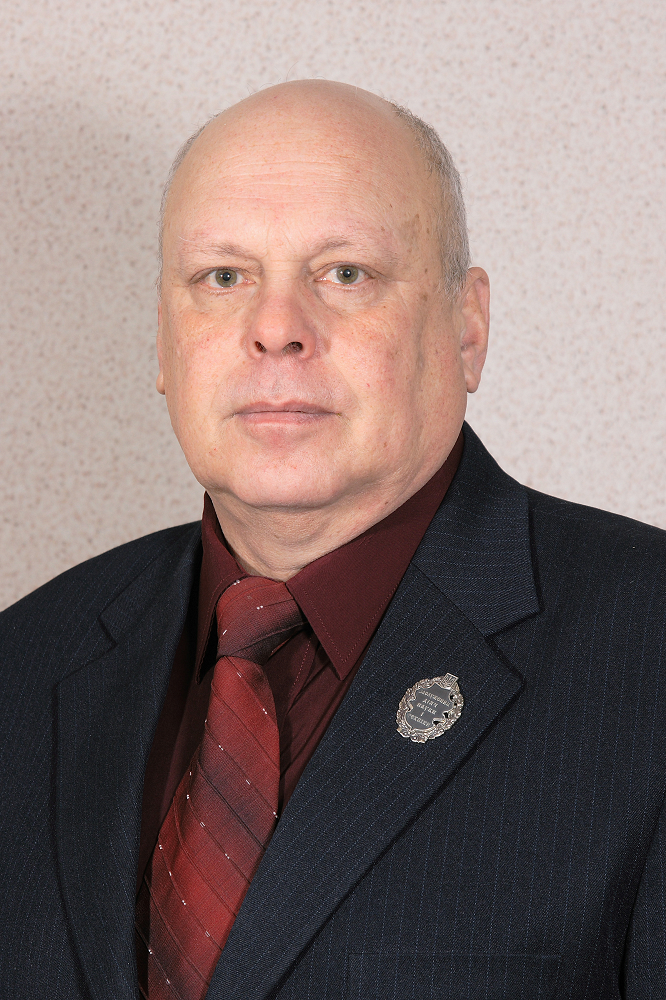
Oleg "ILLICH" Sukharevsky
1950 - 2026
Oleg "ILLICH" Sukharevsky has been working in the field of applied mathematics and computational electrodynamics since 1972, when he graduated from Kharkov Gorky State University with a degree in computational mathematics and joined the Kharkov Govorov Military Academy of Air Defence as an engineer.
From 1977 he began his own study and development of numerical computational methods based on the solution of two-dimensional integral equations to obtain scattering characteristics of non-closed screen and antenna under frame radome. In 1983 he obtained the Candidate of Technical Science degree (Ph.D. analogue) from the All-Union Research Institute of Radiotechniques, by that time he was promoted to the position of Senior Researcher. Since then, he has continued to study the scattering phenomenon and started to develop the scattering theory and technique for calculating the radar cross section of complex objects, with special emphasis on the objects that have surface fractures (sharp edges) and are (partially) covered with radar-absorbing materials. In 1993, he received a Doctor of Science degree in radar from the Kharkov Govorov Military Academy of Air Defence.
Since the collapse of the Soviet Union in 1991, Oleg Sukharevsky has held not only academic positions but also teaching posts in applied mathematics and computational electrodynamics at the Govorov Academy, which was reorganised in 1993 as the Kharkov Military University and later, in 2004, as the Kharkov Kozhedub Air Force University. From 1996 to 2001 and from 2004 to 2008, he was also employed as a senior researcher at the Usikov Institute of Radio Physics and Electronics of the National Academy of Sciences of Ukraine.
During the turbulent period that followed the collapse of the Soviet Union, he founded a scientific school that has produced many prominent Ukrainian engineers and scientists. This was also the time when the explosive growth of computer power opened up entirely new possibilities for implementing theoretical electrodynamics methods in operational software. The appearance of personal computers facilitated the development of computer models of a number of air, ground and underground objects, and Oleg Sukharevsky and the graduates of his academic school gained extensive experience in the simulation of scattering from real radar objects interrogated by not only narrow-band, but also wideband and ultra-wideband interrogation signals. He is the author and co-author of ten books and more than 250 papers in Russian, Ukrainian and English. Oleg Sukharevsky is a senior member of IEEE and Honoured Science Worker of Ukraine.
His main areas of interest included, but were not limited to, the mathematical theory of diffraction and scattering characteristics of radar targets
ILLICH was very ill in recent years. When he went to Germany for treatment, we all hoped for a miracle. The treatment gave him several more years of life. Unfortunately, the miracle did not happen...
He will always be with us as long as we remember him.